
Airbnb 2025: new city rules
Caps and procedures to check before renting a furnished tourist accommodation in Paris, Lyon, Marseille and other cities.
- 1Why 2025 is a key year for Airbnb regulation?
- 2Paris: the capital tightens the screws further
- 3Lyon: priority for residents and rules for second homes
- 4Marseille: registration and change of use
- 5Nice, Bordeaux, Biarritz: very different local strategies
- 6The general obligations for all hosts in 2025
- 7How to adapt to the new regulations?
- 8Conclusion: a new reality that can also open opportunities
- 9Frequently asked questions
The essentials. The new Airbnb rules for 2025 depend on the city and the status of the property. Paris has limited tourist rental of a main residence to 90 days per calendar year from 1 January 2025; Lyon also applies a 90 day cap. For a second home, a registration number never replaces a possible authorisation for change of use. Before publishing, check the permitted duration, the declaration and the authorisations required at the property’s address separately.
Large cities are trying to preserve homes for their residents while maintaining tourist welcome. The practical difficulty for a host is that a rule valid in Paris may differ in Bordeaux, and completing one formality does not exempt you from the others.
Why 2025 is a key year for Airbnb regulation?
Updated 2 October 2026. Law no. 2024-1039 of 19 November 2024, known as the Le Meur law, broadened the powers available to municipalities to regulate furnished tourist accommodation. In 2025, some lowered the allowed rental period for main residences; others amended their authorisation conditions. Airbnb has no separate legal regime: the rules also apply to properties offered on other platforms.

The main aims of the new rules
Municipalities want to limit the conversion of housing into tourist accommodation and better control rentals. Platforms’ transmission of data to the tax authorities falls under the DAC7 scheme: this does not exempt the landlord from declaring their income. Local powers and their limits are detailed in our article on the Le Meur law and furnished rentals.
: the rise of the “Le Meur law”
The law allows a municipality to reduce the annual tourist rental period of a main residence from 120 to 90 days if it so decides. It also broadens local tools relating to change of use. It did not automatically lower the cap to 90 days across France.
Paris: the capital tightens the screws further
In Paris, the status of main residence determines the first step. Its tourist rental is limited to 90 days per calendar year; another property requires authorisations before the first letting. The City of Paris explains the formalities for each situation.

The reduced cap: 90 days maximum
Since 1 January 2025, you may not rent your Parisian main residence for more than 90 days per calendar year as a furnished tourist accommodation. The previous limit was 120 days. Add up the nights booked across all your platforms: opening two calendars does not create two caps. Our article on the 90 day cap for holiday rentals explains this calculation.
Why this change?
Paris presents this reduction as a way to protect the stock of permanent housing. The city also requires registration of the furnished tourist accommodation and the display of its number on the listing. For a property that is not your main residence, it requires an authorisation for change of use with compensation as well as a change of destination: registering the listing does not regularise their absence.
An impact already visible
The cap has reduced the number of nights a host can legally offer in their main residence. However, we have not found a municipal assessment attributing a decline in listings in certain arrondissements or a stabilisation of the housing market to this measure alone. These effects should not be presented as established.
Lyon: priority for residents and rules for second homes
In Lyon, a main residence may be rented up to 90 days per year after registration. For a property that is not the landlord’s main residence, the city specifies that the registration number does not equal authorisation: you must apply for change of use before renting. Compensation conditions depend notably on area, size and the owner’s status. The City of Lyon’s guidance page distinguishes these cases.

Main obligations for Lyon hosts
Register the property and display the number obtained on your listings. If it is not your main residence, also submit a change of use request. For an individual and a property under 35 m² outside the city centre, Lyon provides temporary authorisations whose number and duration are limited; other configurations may require compensation. The rule therefore cannot be deduced from the neighbourhood name alone.
Why is Lyon so strict?
Take the studio in Vieux-Lyon whose owner envisages 200 nights of tourist rental per year. If it is their main residence, this plan exceeds Lyon’s cap. If it is another property, counting nights does not replace the examination of change of use: they must submit their project to the city, which will determine the conditions applicable at that address. Sometimes compensation is required. Obtain the answer before promising the nights.
Marseille: registration and change of use
In Marseille, the landlord declares their furnished tourist accommodation on the local tourist tax portal and obtains a registration number to display on their listings. For a property other than their main residence, an authorisation for change of use is required from day one. The City of Marseille details the two procedures.

A mandatory 13-digit number
Marseille issues a 13 digit registration number after validation of the host account. It must appear on every listing. Keep the receipt accessible: it proves the declaration, not an authorisation for change of use.
Tourist tax and fiscal data transmission: two separate channels
Do not confuse the data channels. The tourist tax follows its own declaration and collection rules; platforms also transmit information to the tax authorities under DAC7.
Impact in Marseille
Registration gives a traceable procedure for hosts and the city. It does not, on its own, prove that irregular listings have fallen or that nuisances have decreased. At the date of this update, we have no official assessment supporting those claims.
Nice, Bordeaux, Biarritz: very different local strategies
The common thread is control over the conversion of housing. The methods really differ from one municipality to another: compensation in Bordeaux and Biarritz, zone-based authorisations in Saint-Malo, a new change of use regulation in Nice since September 2026. Do not apply to your property a rule read for the neighbouring city.

Nice: detailed regulation by neighbourhood
The Métropole Nice Côte d’Azur states that a new change of use regulation has applied since 1 September 2026 and includes quota zones. This makes the previous description of three fixed categories, “very touristy”, “buffer” and “quiet”, obsolete. For a specific property, check the zoning and the conditions of the regulation in force. Mixed lettings between the academic year and the summer tourist season also require a dedicated procedure; we have not confirmed the previous claim that all student sublettors had to obtain a specific one-year authorisation.
Bordeaux: change of use and compensation
Bordeaux subjects the conversion of a property into tourist accommodation to an authorisation for change of use with compensation, according to the presentation published by the city. This rule has existed since 1 March 2018: presenting it as a quota introduced in 2025 would be misleading. A main residence rented within the city’s indicated limit falls into another case. Before buying to let as tourist accommodation, check whether the compensation is feasible.
Biarritz and Saint-Malo: tourist tensions
In Biarritz, the regulation applicable to several municipalities in the Basque Country subjects new furnished tourist accommodation to the principle of compensation, with defined exceptions, notably for certain mixed lettings. In Saint-Malo, the temporary authorisation for change of use depends on a quota in the housing sector. These mechanisms are not interchangeable: a possible compensation in Biarritz does not tell you how many authorisations remain in a Saint-Malo sector.
This table shows the question to resolve before going live. Above all, it prevents taking the registration number for a general authorisation.
| Ville | Règle vérifiée | Ce que l’hôte doit trancher avant de publier |
|---|---|---|
| Paris | 90 jours pour la résidence principale ; autorisations supplémentaires pour un autre logement | Le bien est-il votre résidence principale, ou faut-il d’abord obtenir le changement d’usage et de destination ? |
| Lyon | 90 jours pour la résidence principale ; changement d’usage pour un autre logement | La surface, le secteur et votre situation déclenchent-ils une compensation ? |
| Marseille | Enregistrement local ; changement d’usage hors résidence principale | Avez-vous l’autorisation requise en plus du numéro ? |
| Nice | Nouveau règlement de changement d’usage depuis septembre 2026, avec zones à quotas | Quelle règle s’applique à l’adresse exacte du logement ? |
| Bordeaux | Changement d’usage avec compensation pour transformer un logement en hébergement touristique | La compensation est-elle réalisable avant l’achat ou la conversion ? |
| Biarritz et Saint-Malo | Compensation avec exceptions à Biarritz ; quotas sectoriels à Saint-Malo | Votre projet entre-t-il dans une exception, ou reste-t-il une autorisation disponible ? |
The general obligations for all hosts in 2025
A tourist rental can require several procedures. The declaration of the furnished tourist accommodation, the registration with a number, the authorisation for change of use and the tax obligations address different questions. The details of the documents and formalities are in our list of required documents for a furnished tourist accommodation.
Mandatory declaration at the town hall
The simple declaration of a furnished tourist accommodation is made at the town hall, except when the property is the landlord’s main residence. In a municipality that imposes registration, however, the procedure also concerns main residences. To distinguish procedures, consult our guide to declaring a furnished tourist accommodation, then the online service of your town hall.
Displaying the registration number
When registration applies, enter the number obtained on every listing. Do not confuse it with a tax reference number or with an authorisation for change of use. the page on French regulation of short-term rentals gives national signposts; the town hall confirms the local regime.
Respecting the annual cap
The cap reduced to 90 days applies only where the municipality has adopted it. It concerns tourist rental of the main residence, and is counted per calendar year, across all platforms. Check the municipal decision before reopening your calendar: Paris and Lyon apply 90 days.
Change of use for second homes
In cities that regulate this use, renting touristically a property that is not your main residence may require an authorisation from the first stay. Simply filing a declaration or obtaining a number is not enough. Also check the building regulations and, if you are a tenant, your right to sublet.
Tax obligations
Declare rental income according to the regime that applies to your activity. Check who collects and remits the tourist tax for each booking: the platform may do so in some cases, but that does not justify ignoring your direct bookings. The DAC7 scheme transmits information to the tax authorities; compare its summary with your own accounts.
How to adapt to the new regulations?
Start with a file for each property, containing its address, its status as a main residence or not, the registration number and the authorisations obtained. Add the applicable annual limit and the nights already let. This document serves to verify a listing; a welcome book, however comprehensive, does not replace any town hall procedure.
Keep informed regularly
Check your town hall’s page before each season and after any change to the property or your activity. Nice, for example, changed its regulation in September 2026. A screenshot of your old file does not prove that the conditions for a new application are identical.
Professionalise your management
Keep a single calendar if you publish on several platforms. Keep receipts, authorisation decisions and the count of nights with your accounting documents. A question from the town hall is better handled with a date and a document than with the memory of a calendar.
Optimise your listing
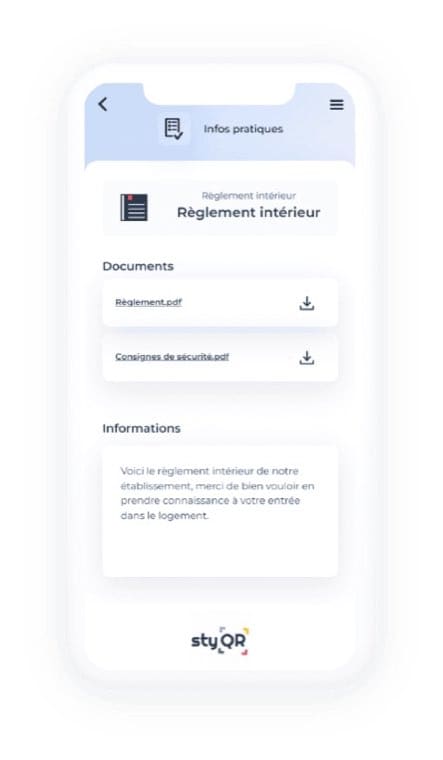
A shorter permitted period may lead you to review open dates, rates and minimum stay lengths. Do not promise an autonomous check-in or equipment whose instructions are out of date. At StyQR, we observe internally that 40% of welcome book consultations are in a language other than French: check especially that your arrival instructions remain understandable for these guests. The update of a digital welcome book corrects information intended for the guest; it does not change the listing or your authorisations.
Consider medium-term rental
A furnished rental with an assured tenancy agreement can be another strategy for a property you no longer wish to offer to transient guests. It nevertheless requires reviewing the appropriate lease, the tenant’s situation and the rules specific to this rental mode. Do not present an extended tourist stay simply as a way to circumvent a change of use.
Conclusion: a new reality that can also open opportunities
Local rules do not ban tourist rental everywhere. They require distinguishing feasible projects from those that need prior authorisation or compensation. An owner who checks this before opening their calendar avoids building a season on nights they cannot offer.
Once the procedures are completed, hosting remains a separate task. For a property occasionally let to friends and family, a shared document may suffice; the StyQR solution for short-term rentals mainly makes it easier to update and share instructions with guests. It does not certify the property’s compliance.
Frequently asked questions
How many days can I rent my main residence in 2025? It depends on the municipality. Paris applied a 90 day cap per calendar year from 1 January 2025, and Lyon also indicates 90 days. Do not assume this figure applies everywhere: check your town hall’s decision.
Do I have to declare my property at the town hall even in a small municipality? The simple declaration applies to furnished tourist accommodation, except when the property is the landlord’s main residence. Where a registration procedure is imposed, it also concerns that main residence. The size of the municipality is therefore not enough to determine the procedure.
What is change of use and who should apply for it? It is the authorisation to consider when a residential property is used for tourist rental in a municipality that regulates this use. It concerns projects involving a property other than the main residence. In Lyon, the owner of the Vieux-Lyon studio envisaged for 200 nights must have their project examined before letting; the registration number does not settle the question.
Are the rules the same across the city? Not always. Lyon adjusts some authorisation conditions by area and size; Saint-Malo applies quotas by sector. In Nice, you must now consult the regulation that came into force in September 2026, rather than rely on the old description of three zone types.
Do platforms transmit my income to the tax authorities? Yes, the DAC7 scheme provides for platforms to transmit information to the tax authorities. This does not replace your tax return. The tourist tax follows distinct collection rules, to be checked for your direct bookings and those made through a platform.
Is medium-term rental a good solution if I lose nights? It can suit you if you genuinely want to switch to another rental mode and use the appropriate lease. It does not automatically convert tourist rental into residential tenancy. Compare the project, its rules and expected income before changing your listing.
On the same topic