
Free welcome book: when it really is enough
The three ways to make a welcome book without paying, what each one costs you the day a piece of information changes, and the exact signal that it is time to move to a paid tool.
- 1When free really is enough
- 2The three free options, and what they can do
- 3What each option costs you the day a piece of information changes
- 4The tipping point: the same text message twice
- 5What you're paying for, exactly
- 6And when the digital welcome book is free, who pays ?
- 7The free template, with no form to fill in
- 8Frequently asked questions
The essentials. A free welcome book is enough as long as you have a single property, few weeks booked and French-speaking guests : a Word document, a Canva design or Airbnb's house manual will do the job. Free costs time : a PDF or a Canva design has to be redone every time the wifi code changes, and it doesn't translate itself. What you pay for with a digital welcome book is the one-off update and the languages. The tipping point is when you answer the same text message twice.
When free really is enough
People look for free because they are starting out, with one or two properties. That's a good reason, and in a fair number of cases the honest answer is : stay free.
Three conditions, and you need all three.
- A single property, whose codes you know by heart.
- Few weeks booked : a handful of bookings a year, not a calendar full from May to September.
- Guests who read French, or stays where you are there in person to welcome them.
On language, a PDF can't fake it: it isn't interactive. The day you want to translate it, you redo it, page by page, and you reprint it. As long as your bookings fit on one hand, that's bearable. Beyond that, it's a lot of paper.
If what's holding you back is the paper itself, because your guests are older or not comfortable with a phone, that question is covered in our comparison between a digital welcome book and a PDF. The short answer : it goes better than people fear, and nothing stops you keeping a printed sheet alongside it.
As for free digital versions: either they're limited, or there's something fishy going on. You can't give everything away and keep a quality product. So who pays? There are only three possible answers, and they're further down this article. What you're looking for is a welcome book that suits you, an interface that suits you, and support that answers.
For a property let out three weeks a year, free is enough. You print two pages, you put them on the table, and you correct them with a pen the day the gate code changes. Nobody needs a subscription for that, and selling you one in that situation would do you no favours.
What usually makes the difference is almost never how many pages the welcome book has. It’s how often you update it, and how many languages it needs to be readable in.
The three free options, and what they can do
There are three ways of making a welcome book without paying. They are not equivalent, and none of them is bad : they simply fall down on different things.
A Word document, exported as a PDF
The simplest, and the most durable. You write the seven sections in the order of the stay, you export, and you send the file by message before check-in. Content matters more than layout : we have written the complete template, section by section, with a worked example, and it can be copied into any word processor.
Its limitation is mechanical. The file the guest downloaded on Tuesday will never change again, even if you correct yours on Wednesday.
Canva
The result often looks good, and the free plan is more than enough for six well-kept pages. Translation, though, quickly runs into the format : Canva's translation tool works one language at a time, up to a limit of 2,000 characters, and produces a copy of the design. Four languages means four files to correct the day the wifi password changes. We have set out elsewhere what really changes when you move from a Canva PDF to a welcome book that can be read online.
Airbnb's house manual and guidebooks
This is the most underused free option, and the one with the best effort-to-result ratio if you only let through Airbnb. Two separate fields : the house manual, for how the property works, and the guidebooks, for your local recommendations.
Two details to know before betting everything on that. Only guests with a confirmed reservation can access the house manual, according to Airbnb’s Help Centre: a guest who booked via Booking, Abritel or your own website will never see it. And guides are tied to an individual host account and not to a listing, which prevents your co-hosts from editing them. Sources.
In other words : excellent as long as Airbnb is your only channel. The day you let elsewhere, you have two welcome books to maintain, and only one of them is up to date.
What each option costs you the day a piece of information changes
Here is the same incident, the one that happens to everybody, handled by each of the four options. The last column isn't there for decoration : it's the only one where you do the job once.
| The situation | Word or PDF | Canva | Airbnb house manual | Digital welcome book |
|---|---|---|---|---|
| The wifi password changes in August | You correct it, re-export it and resend the file to current bookings | Same, and once per language | Corrected in the listing, visible straight away | Corrected once, everyone sees the up-to-date version |
| An Italian guest arrives at 11 pm | They photograph it and translate it themselves | You need one file per language, created in advance | Only for guests who booked on Airbnb | Shown in the phone's language, with nothing to prepare |
| You open a second listing on Booking | One more file, almost identical | One more design to duplicate | Unusable outside Airbnb | The same link, or one welcome book per property |
| You want to know what guests are looking for | No idea | No idea | No idea | You can see which sections are opened |
| There's no network coverage in the hamlet | Paper wins | Paper wins | Not accessible | You need a connection to open it the first time |
The last point is a real limit on our side, and it deserves to be said : if your property is in a dead zone, leave a sheet with the codes on the table, whatever tool you use. A QR code without a network is a pretty mosaic.
The tipping point: the same text message twice
The tipping point is when you answer the same text message twice. Not at your tenth property, not when you turn professional : the second time you type out the gate code on your phone keyboard, for two different guests, because the welcome book didn't say it clearly enough.
These messages rarely arrive at 3 pm. They arrive at 11.40 pm, and they all look alike: the code, the bins, the wifi. A well-filled welcome book won't spare you a phone call, nothing will. It removes the recurring questions, the ones you already answered the week before, word for word, to somebody else.
The rest is a matter of boundaries. A guest who has the information to hand and still writes to you at an unreasonable hour is an isolated case, not your daily life. That's where the difference lies: you answer because you decide to, not because your welcome book forces you to. That's mainly what you gain, and it shows up in no profitability calculation.
That question asked twice is worth more than any profitability calculation. It tells you two things : your welcome book has a gap, and it needs filling somewhere the fix also benefits the next guest. With a file, that isn't the case. The next guest will receive the same version, the one you haven't reopened yet.

What you're paying for, exactly
A digital welcome book is a private web page, specific to one property, which the guest opens by scanning a QR code or clicking a link, and which the host can update at any time without reprinting anything. That's all. You write the content yourself : it's the same content as in your Word document.
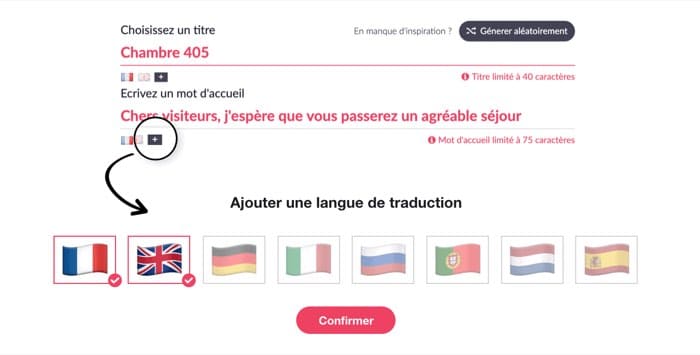
What you pay for with a digital welcome book is the one-off update and the languages. The rest is convenience. With StyQR, a correction reaches every guest currently staying, and the welcome book is displayed in the language of the guest's phone, across 14 languages. Out of the 35,000 welcome books created since 2019, 40% of views happen in a language other than French, and 91% on mobile. That's the argument that most often decides it, well ahead of design.
The price : 49 € excl. VAT per year per welcome book for a rental, a gîte or a bed and breakfast, a little over 4 € a month, with a 14-day trial and no card details. For properties open only a few weeks a year, there is a seasonal plan from 9.90 € excl. VAT, with the details on the rental pricing table. What that 49 € pays for, concretely : people who reply in under two minutes during opening hours, seven days a week ; a product that has gained, since 2019, the AI assistant, the condition report, the Boutique and the 14 languages ; hosting in Europe that handles a welcome book being opened every 30 seconds, 1.4 million a year.
One thing we won't promise you : a paid welcome book doesn't make empty content interesting. A well-written Word document beats a half-filled digital welcome book, every day of the week.
And when the digital welcome book is free, who pays ?
Free digital welcome books exist too, and they read like any piece of free software : hosting, support and development all cost money, so somebody is paying. There are only three ways of doing it, and knowing them is enough to read any offer.
Your data, and your guests' data. A welcome book contains access codes, addresses and phone numbers, and it records who opens it. A service that lives off that data exploits it for advertising, or builds another product on top of it. If it's free, you are the product : check the terms of use to see who owns the content and what the service is allowed to do with it.
Advertising. A banner in your gîte's welcome book, a link to a cleaning service or a property management company sitting next to your wifi code. Nothing illegal about it, but it's your guest who sees it, under your name.
Nobody. The most common case : the tool is free because there's no team behind it. No support, no updates, and one day no website either. You find out from a guest writing to tell you the link no longer opens, with the QR code already stuck on the fridge.
That leaves the honest model : free as a way of trying it out, time-limited, before a clearly stated subscription. That's ours: 14 days with no card details and every feature included, and nothing is charged if you go no further. Three questions separate any offer, ours included : who answers when a guest is standing at the door and the code doesn't work, what do you get back if you leave, and where is the price written down for three years' time.
The free template, with no form to fill in
We don't ask for an email in exchange for a template. It's written online, readable from start to finish, and you can copy it into whatever format you like. If you let through the platform, the Airbnb welcome book example covers Airbnb's own expectations, self check-in included.
And if you'd rather see before you write, several demo welcome books are open to view : gîte, flat, campsite. Look at them above all for the order of the sections, which is what copies best and costs nothing.
One last marker, to decide without a table : if you're still hesitating, free is holding up. The day it stops holding up, you won't be asking yourself the question, you'll be typing out a code on your phone.

Frequently asked questions
Is there a free welcome book template to download ? Yes, and plenty of them ask for an email in exchange. Ours is written straight into the article devoted to the welcome book template, section by section, with a worked example. You copy it into Word, into Canva or into a digital welcome book : it's the same content.
Is Airbnb's house manual enough ? It's enough if Airbnb is your only booking channel. The Airbnb help centre states that only guests with a confirmed booking can access it. A guest who arrived via Booking, via Abritel or directly will therefore never have access to it, and they will call you.
Can you make a free welcome book on Canva ? Yes, and the result often looks good. The difficulty comes with languages : the translation tool works one language at a time, up to a limit of 2,000 characters, and creates a copy of the design. Each language therefore becomes one more file to correct.
Is a welcome book compulsory ? The document itself isn't. Several pieces of information it contains, however, such as the property's registration number or the safety instructions, must be brought to the guest's attention. The welcome book is simply the most convenient place to bring them together.
How many properties before you need to go paid ? There's no threshold, there's a symptom : the same question asked twice by two different guests. Some hosts with five properties get along perfectly well with files, others switch with a single flat let all year round.
A free digital welcome book: who pays for it ? Your data, advertising shown to your guests, or nobody, and in that last case there is neither support nor updates. Honest free is a time-limited trial ahead of a published price.
On the same topic