
Investing in a jacuzzi: a good idea?
Items to cost, checks before installation and a method to decide whether a room with a jacuzzi will earn more than it costs.
Investing in a jacuzzi can be a good idea for a hotel if the room actually sells for more and if that premium covers the purchase, the work, water, electricity and maintenance. A room with a private jacuzzi is not necessarily managed like a shared hot tub: actual use determines the applicable health rules. Obtain quotes for the complete installation, then calculate the number of extra nights needed before deciding.
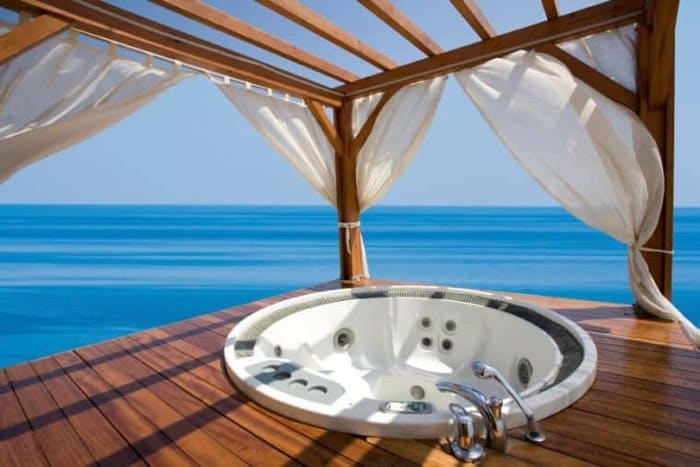
A glass of champagne by a private jacuzzi: the image can attract a couple looking for a special night. It will not, on its own, fill your booking schedule. For your hotel, the question is more down to earth: how much does this room cost to equip, and at what price will you really sell it?

A jacuzzi, how much does it cost?
There is no reliable average price for a “hotel jacuzzi”. The range, jets, lighting, number of seats and the room layout all affect the quote. The manufacturer Jacuzzi® itself lists its spas by request for price: ask for an offer tailored to your establishment rather than using a figure found for a domestic model.
An above-ground unit avoids some embedding work, but it still needs delivery, siting and connections. A built-in model requires access to be planned for maintenance. In both cases, have the floor’s load-bearing capacity checked for the filled equipment and occupants. A slab may be necessary depending on the project; its cost is not deducible from a per-square-metre price that applies everywhere.
Add to the quote ventilation, water drainage, electrical supply, delivery access and reinstatement of the room. Also ask the seller and installer what cleaning, filter replacements and routine maintenance require. To examine the energy item across the establishment, our article on a hotel’s electricity consumption provides a starting point.
An integrated whirlpool bath remains an alternative to consider for a room. Its purchase and fitting can be a different project to a freestanding spa; it also offers a different experience. Compare both on quotation, without promising that a bath will produce the same commercial effect.
| Solution | What to cost | What the comparison must decide |
|---|---|---|
| Above-ground spa | Unit, delivery, floor, connections, ventilation, maintenance | Can the room accommodate the equipment without disproportionate works? |
| Built-in spa | Unit, integration works, technical access, connections, maintenance | Does the desired finish justify the works and remain repairable? |
| Reinforcement or slab, if necessary | Support study and works defined by a professional | Does the project remain viable after a structural check? |
| Whirlpool bath | Unit, plumbing, electrical, ventilation, maintenance | Does a simpler option already meet your guests’ demand? |

How to make the investment pay off?
You can offer the jacuzzi room at a higher rate. You cannot assume it will always be booked, nor that all guests will accept the surcharge. Compare its rate and occupancy with those of a comparable room over the same periods.
The calculation is simple: divide the project’s initial cost by the additional margin actually earned per night. To obtain this margin, deduct from the charged premium the extra expenses related to the equipment and the stay. If the margin is small or bookings are concentrated on a few weekends, payback will take longer than the headline rate suggests.
Also test demand before carrying out works: enquiries received at reception, searches on your booking engine, questions asked on your listings. Note precisely what guests ask for. A shared spa with private time slots does not meet the same expectation as a jacuzzi accessible from the room.
If your clientele only occasionally requests this equipment, offering occasional access to an existing wellness area may suffice. A permanently equipped room fares better when you can clearly sell that difference. The welcome books designed for hotels allow you to explain access and instructions to each guest without turning reception into an instruction manual.
What regulation applies to a hotel jacuzzi?
Updated on 5 October 2026. The distinction concerns the use of the pool, not the word “private” written in the ad. Article 1 of the decree of 26 May 2021 on sanitary control and monitoring of pool waters excludes from the concept of collective use a pool reserved, for the entire stay, for the personal use of the client of a tourist accommodation unit, notably a room. The same text defines collective use for pools open to a group of people whose water is not drained between each bather.
A hot tub shared between several rooms, even if bookable, therefore requires a different analysis. The public health code provides health rules for installations that fall under collective use. Before choosing equipment or promising “private” slots, describe your operation to the installer and ask the competent regional health agency to confirm the regime applicable to your project. A closed door during a slot does not automatically turn a shared facility into a pool reserved for a single room.
This regulatory distinction does not exempt you from maintaining the water and equipment, nor from securing access. Have the installer specify the operations to perform between stays and how to record them. Verify separately with them the electrical constraints, ventilation and works required in your building.
An asset for your hotel’s image
The jacuzzi can give a room a distinct identity, notably for couples seeking an intimate setting. It is an avenue to confront with your clientele rather than a booking guarantee. Our article on how to target and attract your clientele helps frame this question before purchasing the equipment.
Show the actual room, the jacuzzi’s location and exactly what the booking includes. Guests may publish photos of their stay on social networks, but any publicity they provide should not be counted in your profitability calculation. Platforms such as Staycation present hotel experiences with spas; check their terms and how your offer would be described there before relying on that channel.

Then present the room on the your hotel’s website and on your booking platforms. A flattering photo should not imply the spa is in the room if it is located elsewhere. You will avoid disappointment at check-in. The jacuzzi can support the establishment’s image; a high occupancy rate still needs to be proven in your figures.
If your site does not yet detail the differences between rooms, start there. Our tips for presenting your hotel on its website complete this work: the guest must be able to understand what they are booking before comparing rates.
How to explain jacuzzi use to guests?
Indicate before check-in where the equipment is located, whether it is reserved for the room or shared, and how to request assistance. On-site, display brief instructions: start-up, stopping, model-specific precautions and a contact in case of breakdown. Have these validated by the installer rather than improvising a universal manual.
According to our internal data published on StyQR welcome books, 91% of openings occur on mobile. Instructions must therefore be readable on a phone, at the poolside. A QR code displayed near the equipment can open the up-to-date instructions in the hotel welcome book. It does not replace safety indications that must remain visible on site, nor staff in case of an incident. You can provide all this information in your welcome book, whether paper or digital. Your guests will be able to consult the usage instructions at any time without contacting you.
And if the hotel has only a single easy-to-use jacuzzi bath, a clear paper manual may be sufficient. A digital welcome book mainly offers the ability to correct instructions without reprinting and to make them available before the stay. To allocate this expense separately from that of the jacuzzi, consult welcome book rates for hotels.
Frequently asked questions
What is the average price of a jacuzzi for a hotel? No single figure describes an above-ground spa, a built-in model and their installation in different rooms. Request a quote that separates the unit, the works, the connections and maintenance. Then check the floor’s load-bearing capacity.
Can you recoup your investment with a jacuzzi? Yes, if the nights sold at a higher rate produce enough margin to cover the project. This result is not automatic. Calculate it with your rates and bookings, without assuming the room will always be occupied.
Is there a less expensive alternative to a jacuzzi? A whirlpool bath is worth comparing to a freestanding spa on quotation. It does not necessarily offer the same experience and may also require works. Keep the option that meets your guests’ real demand.
How to promote a room with a jacuzzi? Photograph the room as it will be delivered to the guest and describe precisely access to the equipment. Repeat the same information on your website and booking platforms. Do not promise a jacuzzi in the room if it is a shared facility.
What type of clientele is attracted to rooms with a jacuzzi? An offer aimed at an intimate stay may interest couples, but this is not a rule for all hotels. Look at the enquiries you already receive and bookings for comparable rooms. They are more reliable than a guess about your clientele.
Should something be checked before installing a jacuzzi? Have the support, electricity, plumbing, ventilation and access for maintenance inspected. Also specify whether the pool will be reserved for a room for the entire stay or shared among guests. This answer determines the examination of applicable health rules.
On the same topic