

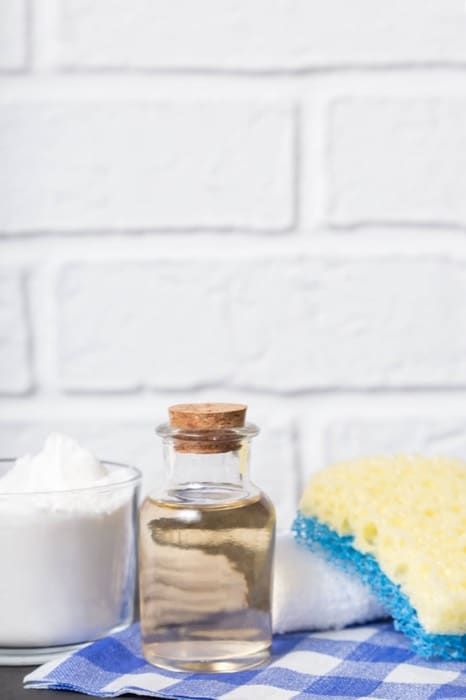
White vinegar: the eco-friendly cleaning weapon
A litre costs less than a euro and replaces half the cupboard. But it doesn't do everything, and on two surfaces it causes permanent damage.
A litre of white vinegar costs less than a euro and replaces your glass cleaner, your descaler and your multi-surface spray. For anyone doing three changeovers in the same day, the saving is far from trivial, and the cupboard empties out.
But plenty of claims circulate about it, some of which will do lasting damage to a property. Here is what it does, what it doesn't do, and the two places you should never use it.
What it genuinely replaces

White vinegar is a weak acid. It dissolves limescale, cuts through light grease and leaves surfaces streak-free. That's all it does, and that's already a great deal.
Diluted by half in a spray bottle, it does an excellent job on windows, mirrors, non-porous worktops, the inside of the fridge and shower screens. Neat and warmed, it descales kettles, coffee machines and shower heads better than most products sold for the purpose. It also neutralises odours: a bowl at the back of the fridge between two stays is enough to clear away last week's cooking.
It is not, however, a disinfectant in the regulatory sense. It reduces certain bacteria, but if you need to disinfect after an incident, it is no substitute for a product designed for that.
The two surfaces it damages
Natural stone. Marble, travertine, limestone, terrazzo. The acid attacks the calcium carbonate and leaves dull, irreversible marks. A marble worktop cleaned with vinegar for a whole season will need resurfacing. It is the most expensive mistake you can make with a one-euro product.
Old tile grout and cement. Over time, the acid eats into cement-based grout, especially if it is already porous. In a shower used every week, it shows within one or two seasons.
Add to that any appliance whose manufacturer explicitly advises against it: some irons and coffee machines have circuits that the acid corrodes.
Descaling, where it comes into its own

This is where it has no serious rival, and it matters directly for a rented property: a furred-up kettle or a half-blocked shower head ends up in the reviews.
For a kettle, half fill it with neat vinegar, bring it to the boil, leave it for an hour, then rinse three times. For a shower head, take it off and leave it to soak overnight in a bowl. For the dishwasher, a glass of vinegar in the detergent compartment and an empty cycle, once a month.
This table sums up the three descaling uses and their exact method.
| Appliance | Method | Contact time |
|---|---|---|
| Kettle | Fill halfway with pure vinegar, bring to a boil, rinse three times | One hour |
| Showerhead | Remove and soak in a bowl of pure vinegar | Overnight |
| Dishwasher | One glass of vinegar in the detergent tray, empty cycle | Once a month |
The mistake of mixing it with bicarbonate of soda
The fizzing mixture looks impressive, and it achieves nothing. An acid and a base neutralise each other: what is left after the effervescence is salty water. You lose the descaling power of the vinegar and the abrasive power of the bicarbonate in a single move.
Use them one after the other if you want both effects, never together. And never mix vinegar with bleach: the reaction releases chlorine gas, which is toxic in an enclosed room such as a bathroom.
The smell, and what guests make of it
The smell goes as it dries, within fifteen to thirty minutes depending on ventilation. So the problem isn't the smell in itself, it's when the guest walks in.
If your clean finishes at 3.45pm for a 4pm check-in, open the windows while you get on with something else, or keep the vinegar for the rooms you clean first. A few drops of lemon essential oil in the spray bottle are enough to change the perception, without taking anything away from its effectiveness.
One last point that counts for more than you might think: mention in your welcome book that the property is maintained with simple products. A growing share of guests care about this, and those with allergies to fragranced products will thank you for it in their review.
Which brands to choose

Supermarket white vinegar at 8% does the job in almost every case. The so-called household versions, more concentrated (12 to 14%), are useful for heavy descaling and can be diluted the rest of the time.
Three products come up again and again among hosts who buy in bulk: L'Arbre Vert household spirit vinegar, Ecolabel certified, Briochin household vinegar, made in France, and the eco-detergent concentrates sold in five-litre containers, which are considerably cheaper per litre.
A five-litre container, a labelled spray bottle and two microfibre cloths: that's the starter kit, and it will last a whole season.
If you delegate the cleaning, the two forbidden items (marble and old grout) should be included in the written instructions, not mentioned as a verbal reminder on the first day. A checklist for each property, like the one offered by CleanClac for eco-friendly cleaning in short-term rentals, is read on the cleaner's phone at the moment they have the spray bottle in hand.
Frequently asked questions
Does white vinegar actually disinfect? No, not in the regulatory sense. It cuts down some bacteria, but when a real disinfection is needed after an incident, use a product designed for that. For routine cleaning between two stays, it does the job.
Can I clean a marble worktop with white vinegar? Never. The acid attacks the calcium carbonate in natural stone, whether marble, travertine, limestone or terrazzo, and leaves dull marks that cannot be undone. One season of that and the worktop needs resurfacing.
Should I mix vinegar and baking soda? No. An acid and a base neutralise each other, and all that is left once the fizzing stops is salty water. Use them one after the other if you want both effects. And never mix vinegar with bleach: the reaction releases chlorine gas, which is toxic in a closed room.
How long does the vinegar smell take to go? Fifteen to thirty minutes depending on ventilation, since it disappears as the surface dries. The real issue is the check-in time: if the clean finishes at 3:45 pm for a 4 pm arrival, open the windows while you get on with something else. A few drops of lemon essential oil in the spray bottle also change how it is perceived.
Should I buy 8% vinegar or the stronger household version? Supermarket white vinegar at 8% covers almost every use. The household versions at 12 or 14% are there for heavy descaling and get diluted the rest of the time. Bought in volume, a five-litre container works out clearly cheaper per litre.
How do I descale a kettle with white vinegar? Fill it halfway with neat vinegar, bring it to the boil, leave it for an hour and rinse three times. For a showerhead, unscrew it and soak it overnight in a bowl. For the dishwasher, a glass of vinegar in the detergent compartment and an empty cycle, once a month.
On the same topic